From the Ingenio website – Media Partner of the III FABRE Conference.
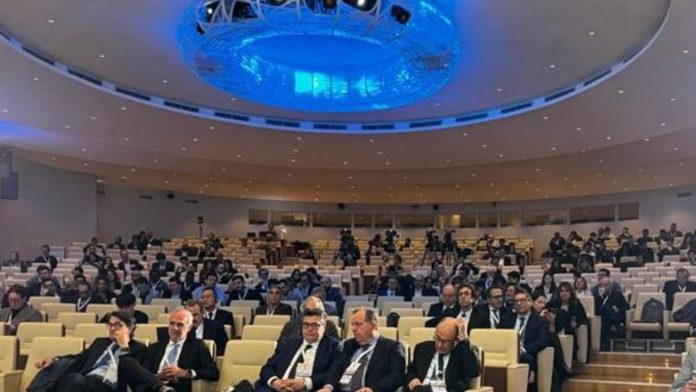
The morning of February 16, the first day of the Third FABRE Conference, opened with institutional presentations by Walter Salvatore, president of the Fabre Consortium, Massimo Sessa (Higher Council of Public Works), Emanuele Renzi (ANSFISA), and Angelo Gemelli (Anas S.p.A.).
In the session dedicated to Sessa, the focus was on the New Technical Standards and their relationship with the upcoming Eurocodes. During the discussion, Andrea Dari—who moderated the session—posed a question about the role of the Guidelines approved in April 2020 in enabling a more structured approach to the maintenance and safety of infrastructure assets in recent years. President Sessa highlighted how the Guidelines have provided a true “methodological” support for the regulatory process, which is destined to continue and consolidate in the NTC, with one element destined to have a concrete impact on the work of technicians: the introduction of the reliability level of existing works, a parameter that may initially generate operational complexity but which must become a standard design tool.
Strait of Messina Bridge: Final Design, Construction, and Wind Monitoring
Among the most popular moments of the morning was the invited presentation by Achille Devitofranceschi (Stretto di Messina S.p.A.) dedicated to “The Strait of Messina Crossing Project – Performance and Technical Aspects.”
This presentation was particularly effective in outlining the framework of the final design, focusing not only on construction and technological solutions but also on the system of inspections and controls developed to assess the effects of wind on the structure. This topic, not surprisingly, returned to the forefront of the discussion at the subsequent roundtable.
Extreme Winds and Climate Change: From Experimental Data to Regulatory Implementation
The roundtable “Load Modeling and Response of Long-Span Bridges to Extreme (Non-Synoptic) Winds” addressed a topic that is becoming a design aspect to be taken into due consideration: intense, concentrated, non-synoptic extreme events with potentially severe effects on buildings and infrastructure.
The session was moderated by Claudio Borri (IAWE, University of Florence) and Fabio Brancaleoni (E.D.IN. S.r.l. and Sapienza University of Rome) and featured presentations by Allan Larsen, Santiago Hernandez Ibanez, Maria Pia Repetto, and Giorgio Diana.
The focus was on the quality and adequacy of available databases, wind tunnel studies, and the prospect of their evolution leading to possible regulatory adoption.
Hydrogeological Instability: A Preview of the “White Paper”
Also in the morning, Silvia Paparella (Ferrara Expo S.r.l.) presented a preview of the work on “Hydrogeological Instability and Transport Infrastructure in the Light of the First White Paper,” an initiative developed with ANSFISA and RemTech. This content will be officially presented on March 5th in Reggio Calabria.
Two in-depth discussions before the parallel sessions: hydraulics and geotechnics
In the afternoon, before the start of the parallel sessions, she presented two “vertical” presentations very consistent with the FABRE 2026 approach.
- Hydraulics – Invited presentation by Diego Panici (University of Exeter, UK): “Built to Last? Identifying and Quantifying Hydraulic Actions from Large Woody Debris Accumulations at Bridges,” moderated by Armando Brath, Francesco Ballio, and Andrea Dari.
A focus on hydraulic risk related, among other things, to the accumulation of woody material near piles and the effects on safety and management. - Geotechnics – Invited presentation by Edward Nicholas Bromhead, moderated by Vincenzo Simeone and Paolo Simonini, on the impact of landslides on infrastructure, particularly piles.
Parallel sessions: from management to post-tensioning, from monitoring to hydraulics and landslides
From mid-afternoon on the first day, the “technical heart” of the conference began with the parallel sessions, organized by area of expertise.
This approach allows for an overview of the state of the art (and critical application issues) in management, monitoring, hydraulics, landslides, and post-tensioning, and will continue in the coming days with a broad and specialized program.